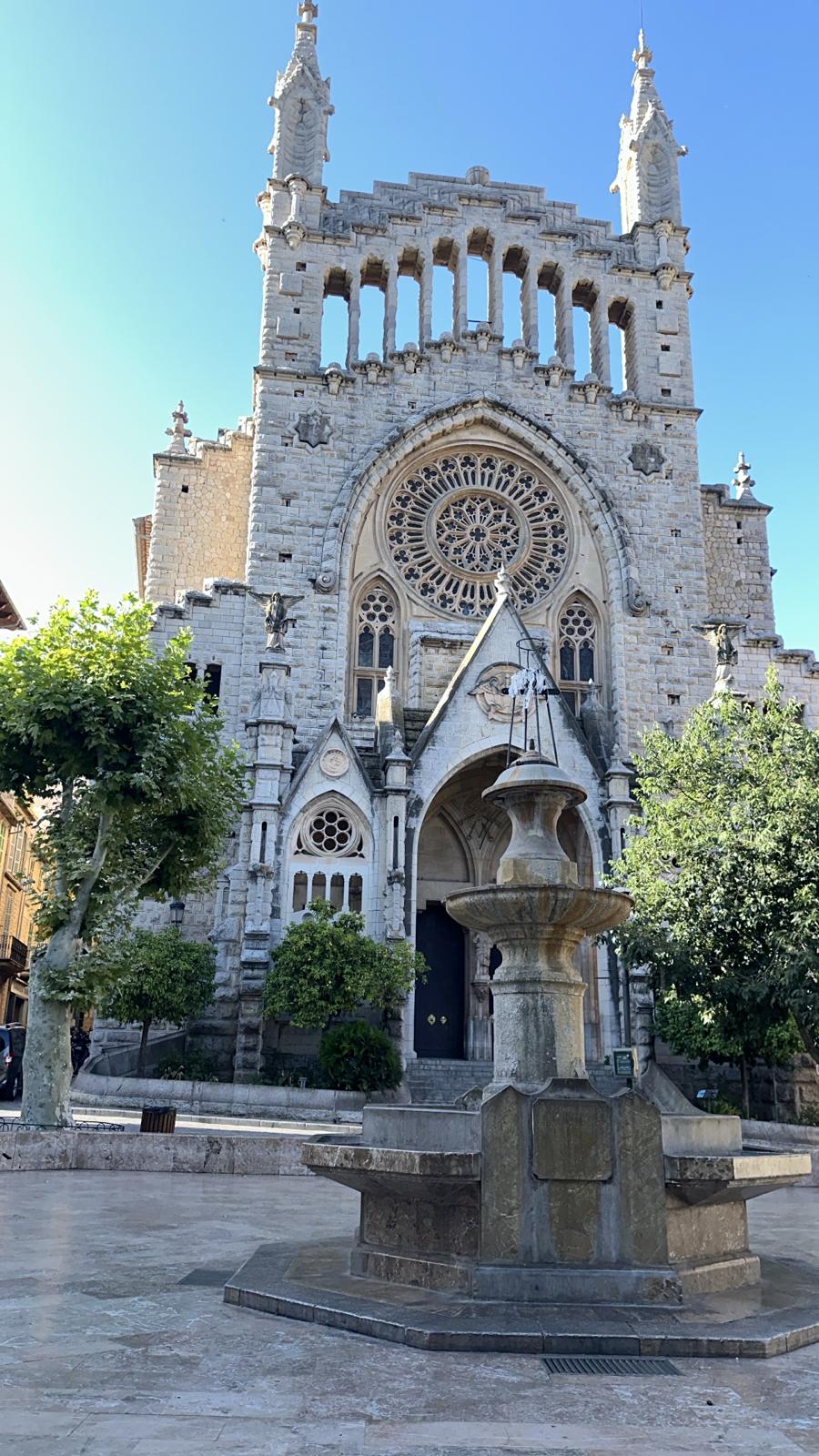
One of the great joys of visiting Sóller is experiencing its living history. Two standout symbols of Sóller’s heritage are the historic wooden train that has connected Sóller with Palma for over a century, and the magnificent Sant Bartomeu Church that presides over the town’s main square. Both are enduring icons that offer a window into Sóller’s past and culture. In this post, we take a journey on the famed Tren de Sóller and step inside the town’s “cathedral” to discover the stories behind these treasures.
The Historic “Orange Express” Train of Sóller
Opened in 1912 during the height of Sóller’s citrus boom, the Ferrocarril de Sóller (Railway of Sóller) is far more than a means of transportation – it’s a moving museum and a must-do experience for visitors. The idea for a railway arose because the Sóller valley was long isolated by mountains; transporting people and the valley’s abundant oranges to Palma required traversing a steep winding road over Coll de Sóller. Prosperous orange and lemon exports provided the funds to finally build the railroad, tunneling through the Tramuntana range. On April 16, 1912, the first train chugged out of Palma’s station bound for Sóller – on the very same day, coincidentally, news reached Mallorca that the Titanic had sunk. Despite that ominous timing, the Train of Sóller was a rousing success and quickly became the pride of the island.
From the moment you board the vintage train at Palma’s Estació del Ferrocarril, you’ll feel whisked back to the early 20th century. Gleaming hardwood coaches with brass lamps and mahogany panels retain their original elegance. Settle into a leather-upholstered seat as the conductor blows the whistle and the train lurches forward with a nostalgic sway. The hour-long journey covers about 27 km (17 miles) and is packed with scenery and engineering marvels. The route winds through the Serra de Tramuntana mountains via 13 tunnels (the longest nearly 3 km), numerous bridges, and even a 360-degree loop that helps the train gain elevation. As you peek out the window, you’ll see the landscape transform from Palma’s flat plains to pine forests, almond groves, and dramatic rocky slopes. Midway, the train makes a short stop at the Mirador Pujol d’en Banya viewpoint, where everyone can step off to admire a breathtaking panorama of the Sóller Valley far below. Have your camera ready – this lookout offers a sweeping view of terraced olive orchards and the distant shimmer of the sea.
Resuming the journey, the train descends into the “Valley of Oranges”. With each tunnel exit, passengers are treated to snapshots of Sóller’s patchwork of green orchards and stone farmhousest. Finally, the train lets out a triumphant horn blast as it arrives at Sóller’s station, a charming old building that once was a 17th-century manor house. Here, you can visit a small art gallery inside the station featuring original ceramics by Picasso and engravings by Miró – a delightful surprise for art lovers.
Be sure to also ride the connecting Sóller Tramway, which was inaugurated in 1913, just a year after the train. The electric tram – painted orange, fittingly – trundles from Sóller’s train station down to Port de Sóller along a 4.9 km line. These tram cars are the very ones delivered in 1913, still in operation over a century later. As the tram clangs its bell and departs, it runs right through the center of town, passing markets and backyards (locals might wave as you pass). Soon it rattles into the countryside, rolling under citrus trees so close you could almost pluck an orange. The tram then runs along the shore to terminate by the port’s sandy beach – offering a charming arrival to the seaside. Taking the tram is like riding a piece of history, and the open-air cars provide wonderful views (and photo ops) of both town and coast. Together, the train and tram form an unforgettable heritage ride that has become a hallmark of Sóller – truly a journey where “the destination is the journey”.
Sant Bartomeu Church – The “Cathedral” of Sóller
Back in Sóller’s town square, the Church of Sant Bartomeu (Saint Bartholomew) immediately grabs your attention with its grand, unusual facade. Often nicknamed the “Cathedral of the Valley” for its grandeur, this parish church encapsulates centuries of local history and art in its stones. The church’s origins date to 1236, shortly after the Catalans reconquered Mallorca. Over time it has been expanded, fortified, and rebuilt, mirroring Sóller’s fortunes and trials. In fact, on the church’s left side you can still see a thick 16th-century defensive wall, erected after a devastating pirate attack in 1561 – a reminder that coastal towns like Sóller had to fend off Ottoman and North African corsairs.
The bulk of the current structure was constructed between 1688 and 1733 in Baroque style. However, it’s the striking facade that truly makes Sant Bartomeu unique. In the early 20th century, Sóller’s thriving orange trade brought considerable wealth, and the town embarked on beautification projects. In 1904, Joan Rubió i Bellver, an accomplished architect and protege of Antoni Gaudí, was commissioned to redesign Sant Bartomeu’s facade. Rubió gave the church a dramatic Modernista (Art Nouveau) face, blending Neo-Gothic form with modern touches. The result is a masterpiece: a gigantic central rose window and arched entry are flanked by two slender towers, and above them an array of vertical openings and stone lattices create a surprising lightness. The facade’s gray limestone, quarried locally, has an almost textured appearance that catches the changing light. Rubió’s design cleverly integrated the church with its mountain backdrop – stand back and you’ll see sky and peaks visible through the top openings, a harmonious mix of architecture and nature.
Step inside, and you transition from Modernisme back into Baroque and Gothic influences. The interior is dim and cool, with thick stone columns and several ornate side chapels. Keep an eye out for the Baroque altarpiece of Sant Bartomeu, lavishly gilded, and some medieval relics preserved from earlier centuries. Colorful stained glass windows send shafts of colored light onto the polished pews. If you visit during a service or when the organ is playing, the acoustics are heavenly. Sant Bartomeu remains very much a living church for Sóller’s residents, hosting regular Mass and local festivities (notably the feast of Saint Bartholomew each August). Visitors are welcome to quietly tour most days – a small donation is appreciated. Climbing the narrow spiral stairs to the bell tower isn’t generally open to the public, but you can imagine the panoramic view of the valley the bell-ringer would have!
Outside, take a moment to appreciate how the church dominates the Plaça de la Constitució. The plaza’s layout actually had to be altered during construction because Rubió’s facade project jutted into the street. Next door, also facing the plaza, you’ll see the elegant Banc de Sóller building, which Rubió designed concurrently in 1912. Its stone facade with whimsical curves and ironwork complements the church, showing how one architect transformed the town’s center in one bold stroke. Together, the church and bank create one of the most photogenic town squares in Mallorca.
As you stand in the square with the historic train occasionally clattering by and the bells of Sant Bartomeu tolling above, you truly feel Sóller’s heritage come alive around you. The Train of Sóller and the Sant Bartomeu church are not just tourist attractions; they are proud symbols of the town’s identity. The train speaks to Sóller’s once-remote location and the determination of its people to connect with the wider world, fueled by oranges and ingenuity. The church, with its eclectic architecture, reflects Sóller’s blend of tradition and modernity – a town grounded in its past yet embracing creative innovation. Both sites are a testament to Sóller’s golden age in the early 1900s when commerce, art, and architecture flourished hand in hand.
Visiting these historic gems is essential to understanding Sóller. Ride the Orange Express if you can (tip: take the morning train from Palma for fewer crowds, and consider the open return tram/train combo ticket for a full day excursion).